


Role of Blockchain in Intellectual Property Protection

More than 400 billion dollars in intellectual property are lost to infringement each year in the American market alone. For Italian and global tech entrepreneurs, the risk of stolen ideas and tampered digital assets is growing as innovation speeds up. Blockchain technology promises new security and trust for creators everywhere. This article brings clarity to how blockchain transforms intellectual property management, helping founders protect their innovations and power global growth.
Table of Contents
Key Takeaways
Point | Details |
Blockchain Enhances IP Management | Blockchain provides a secure, decentralized method for tracking and verifying intellectual property, ensuring tamper-resistant records. |
Automated Licensing with Smart Contracts | Blockchain allows for automated management of licensing agreements and royalty distribution, reducing the need for intermediaries. |
Requires Regulatory Navigation | Organizations must understand varying international regulations surrounding blockchain-based IP to ensure legal compliance. |
Address Implementation Challenges | Careful consideration of technical and regulatory challenges is crucial for successful blockchain integration in IP management. |
Defining Blockchain and Intellectual Property
Blockchain technology represents a groundbreaking approach to intellectual property (IP) management, offering unprecedented security and transparency for innovators and creators. Transformative IP protection mechanisms have emerged through this decentralized technological framework, fundamentally reshaping how intellectual assets are tracked, verified, and secured.
At its core, blockchain functions as a distributed digital ledger that records transactions across multiple computers, ensuring that each entry is permanent, transparent, and resistant to modification. For intellectual property management, this means creating an immutable record of ownership, creation dates, and transfer histories. Cryptographic mechanisms like digital signatures enable precise authentication and verification of intellectual property rights, dramatically reducing disputes and potential infringement scenarios.
The key components of blockchain that make it powerful for IP protection include:
Decentralized record-keeping
Cryptographic security protocols
Transparent transaction histories
Immutable documentation trails
Instant verifiability of ownership claims
Traditional IP management systems often rely on centralized databases vulnerable to manipulation or loss. Blockchain disrupts this model by distributing information across a network, making unauthorized alterations practically impossible. Each transaction or ownership transfer becomes a permanent, traceable event that can be independently verified by network participants.
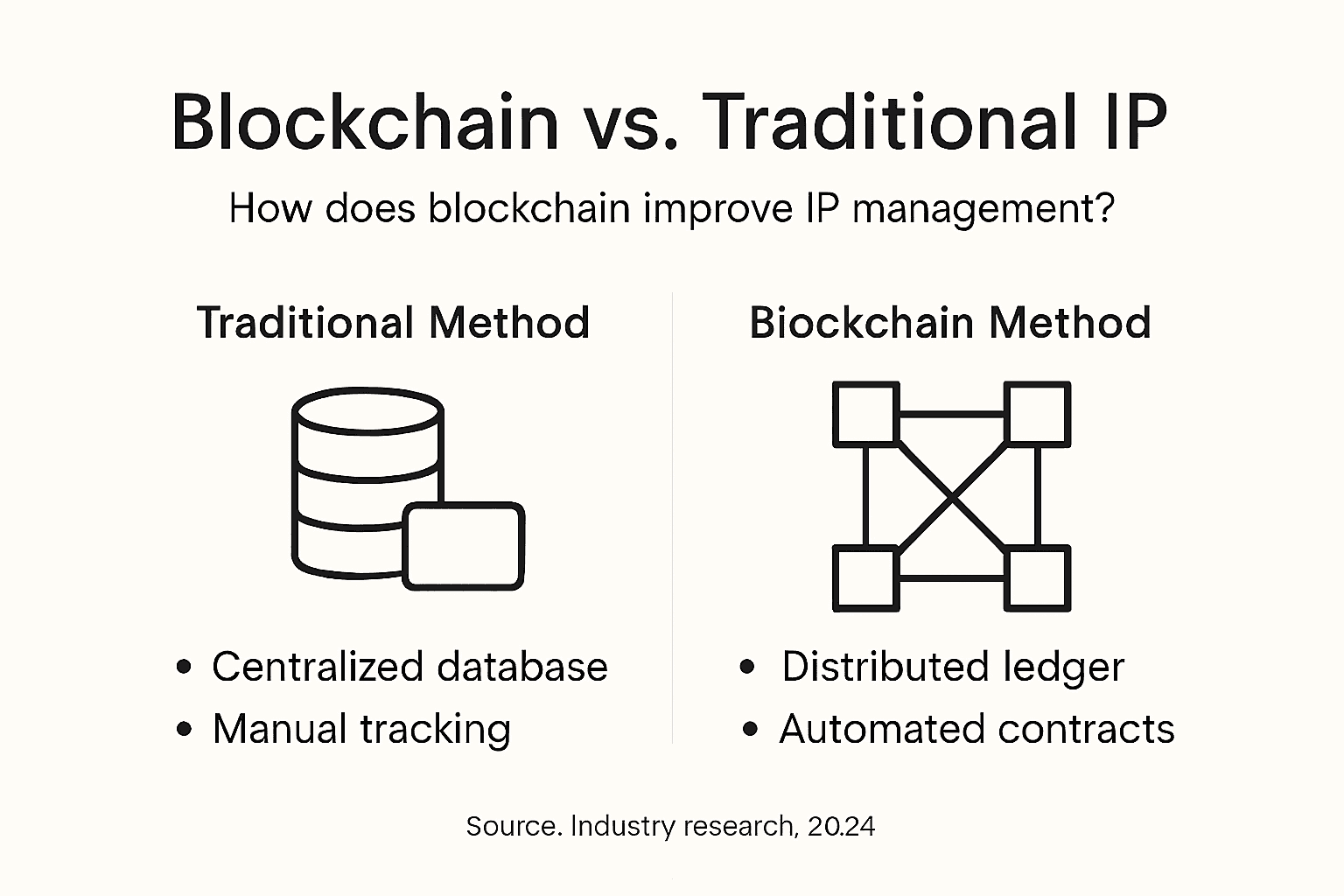
Here’s a summary of how blockchain compares to traditional IP management systems:
Aspect | Traditional IP Management | Blockchain-Based IP Management |
Record Security | Prone to tampering/loss | Tamper-resistant, permanent |
Transparency | Limited, manual audits | Full, real-time visibility |
Ownership Proof | Central registry documentation | Distributed ledger, instant proof |
Dispute Resolution | Complex legal procedures | Automated validation mechanisms |
Pro tip: When registering intellectual property, consider creating a blockchain-based digital certificate to establish an unalterable record of your original creation date and ownership details.
Types of Intellectual Property Blockchain Applications
Blockchain technology offers transformative solutions across multiple intellectual property domains, providing robust protection mechanisms for different types of creative and innovative assets. Blockchain applications span numerous fields including copyright, patent, trademark, and trade secret management, revolutionizing how creators secure and monetize their intellectual property.
In the realm of copyrights, blockchain enables unprecedented tracking and verification of digital content ownership. Musicians, writers, photographers, and digital artists can now create immutable records of their original work, establishing clear proof of creation date and authorship. Innovative IP protection mechanisms allow creators to timestamp their works, preventing unauthorized reproduction and simplifying potential legal disputes.
Blockchain applications for intellectual property protection include:
Copyright registration and tracking
Patent verification and authentication
Trademark ownership documentation
Digital rights management
Royalty and licensing tracking
Proof of originality for creative works
Smart contracts represent another powerful blockchain application in IP management. These self-executing contracts can automatically manage licensing agreements, distribute royalties, and enforce usage rights without intermediary intervention. For instance, a musician could program a smart contract that automatically distributes streaming revenues to collaborators based on predefined percentage allocations, ensuring transparent and instantaneous compensation.
This table highlights common blockchain IP application types and their business benefits:
Application Area | Example Use Case | Key Business Benefit |
Copyright | Timestamping digital art | Reduces infringement disputes |
Patent | Authenticated submission | Speeds up verification process |
Trademark | Tracking ownership changes | Prevents unauthorized transfers |
Royalty/License | Smart contract payments | Automates and ensures accuracy |
Pro tip: Consider documenting your intellectual property creation process through blockchain timestamping to establish a verifiable, permanent record of your original work.
How Blockchain Protects IP Assets
Blockchain technology provides a robust defense mechanism for intellectual property assets through its unique cryptographic and distributed architecture. Decentralized authentication systems enable creators to establish verifiable ownership and track the entire lifecycle of their intellectual assets with unprecedented transparency and security.
The core protection mechanisms of blockchain for intellectual property include cryptographic verification, immutable record-keeping, and automated rights management. Blockchain prevents unauthorized use by creating a permanent, tamper-resistant digital record of ownership that cannot be altered or duplicated without detection. This technological approach fundamentally transforms how intellectual property rights are established, tracked, and enforced across digital and physical domains.
Key protection strategies implemented through blockchain technology include:
Permanent ownership documentation
Instant proof of creation timestamp
Transparent transaction history
Automated royalty distribution
Secure access control mechanisms
Real-time rights management
Cryptographic signatures and smart contracts play a crucial role in IP asset protection. These technological tools enable automatic enforcement of licensing agreements, ensuring that creators receive proper attribution and compensation. For example, a digital artist could program a smart contract that automatically tracks and charges licensing fees whenever their artwork is reproduced, eliminating the need for complex legal intermediaries and reducing the risk of unauthorized use.
Pro tip: Regularly document your creative process and register your intellectual property on blockchain platforms to create an unalterable record of your original work.
Legal Frameworks and Global Compliance
The global landscape of blockchain and intellectual property regulation is rapidly evolving, with governments and regulatory bodies developing comprehensive frameworks to address the unique challenges of digital asset management. Digital asset market regulations are emerging to provide clear guidelines for blockchain-based intellectual property protection, ensuring both innovation and legal accountability.
Understanding the regulatory landscape requires navigating complex international compliance requirements. Securities law framework plays a crucial role in defining how blockchain-based intellectual property assets are classified, traded, and protected across different jurisdictions. This includes critical considerations around asset classification, disclosure requirements, and investor protection mechanisms.
Key aspects of global blockchain IP legal compliance include:
International intellectual property treaty alignment
Cross-border digital asset regulations
Standardized ownership verification protocols
Investor protection mechanisms
Compliance reporting requirements
Jurisdictional recognition of blockchain records
The complexity of global compliance demands a nuanced approach to intellectual property management. Different countries have varying interpretations of how blockchain-based assets should be regulated, creating a challenging landscape for international creators and innovators. Multinational organizations must develop flexible strategies that can adapt to diverse regulatory environments while maintaining the core benefits of blockchain technology’s transparency and security.
Pro tip: Consult with international intellectual property experts who specialize in blockchain regulations to ensure comprehensive legal compliance across multiple jurisdictions.
Managing Ownership, Licensing, and Royalties
Blockchain technology revolutionizes intellectual property management by introducing unprecedented transparency and automation in ownership tracking, licensing, and royalty distribution. Digital rights management systems leverage blockchain’s decentralized architecture to create immutable records of intellectual property ownership, ensuring creators maintain precise control over their assets.

Smart contracts serve as the cornerstone of automated licensing mechanisms, enabling creators to define and enforce complex licensing terms without intermediary intervention. Software licensing platforms demonstrate how blockchain can automatically manage subscription models, track usage, and facilitate real-time royalty payments with unprecedented precision and security.
Key features of blockchain-powered IP management include:
Instant ownership verification
Transparent transaction histories
Automated royalty calculations
Programmable licensing agreements
Real-time usage tracking
Immutable ownership records
The traditional intellectual property management landscape often suffers from inefficiencies, opaque tracking, and complex dispute resolution processes. Blockchain technology addresses these challenges by creating a transparent, decentralized system where every transaction, license transfer, and royalty payment is recorded permanently and cannot be altered. This approach dramatically reduces administrative overhead, minimizes potential legal conflicts, and provides creators with unprecedented visibility into their intellectual property’s lifecycle and economic performance.
Pro tip: Document all intellectual property transactions on blockchain platforms to create an unalterable, transparent record of ownership and licensing agreements.
Risks, Limitations, and Implementation Challenges
Blockchain technology for intellectual property protection, while promising, encounters significant technical and regulatory hurdles that organizations must carefully navigate. Technical risks in blockchain deployment include vulnerabilities in smart contract design, potential scalability limitations, and complex integration challenges across different technological infrastructures.
The implementation landscape presents multifaceted challenges that extend beyond pure technological considerations. Cybersecurity strategic frameworks highlight critical concerns such as data privacy, interoperability between different blockchain protocols, and the delicate balance between maintaining immutable records and allowing necessary corrections or updates to intellectual property documentation.
Key risks and limitations in blockchain IP protection include:
Smart contract vulnerability
Complex governance structures
Scalability constraints
Regulatory uncertainty
Interoperability challenges
Privacy and data protection concerns
High initial implementation costs
Technical complexity for non-technical users
Organizations must approach blockchain implementation with a strategic, nuanced perspective that acknowledges both its transformative potential and inherent technological limitations. Successful integration requires comprehensive risk assessment, ongoing technological adaptation, and a deep understanding of the complex regulatory environments governing intellectual property management across different jurisdictions.
Pro tip: Conduct thorough technical and legal due diligence before implementing blockchain solutions for intellectual property management, and develop a flexible adaptation strategy.
Harness Blockchain to Secure Your Intellectual Property Assets Today
The article highlights how blockchain technology can create permanent, tamper-resistant records of ownership and automate rights management through smart contracts. If you are worried about protecting your trademarks, patents, copyrights, or designs from infringement and want to ensure your IP rights are globally recognized and easily verifiable, you are facing the exact challenges blockchain aims to solve. Managing ownership, licensing, and royalties with complete transparency and instant proof has never been more critical in a digital world full of complex regulations and potential security risks.

Unlock the power of cutting-edge legal and technical strategies tailored specifically for intellectual property protection by visiting Studio Legale Coviello. Our expert team combines deep knowledge of international IP law with advanced technologies, including blockchain integration and AI-powered tools, to help you establish unalterable proof of ownership and automate royalty distributions effectively. Don’t risk delays or disputes with outdated methods. Take control now and safeguard your most valuable assets with innovative IP management solutions designed for the demands of global markets. Learn more about securing your intellectual property rights by exploring our comprehensive services today at Studio Legale Coviello.
Frequently Asked Questions
What is the role of blockchain in intellectual property protection?
Blockchain plays a crucial role in intellectual property protection by providing an immutable and transparent record of ownership, creation dates, and transaction histories. This decentralized technology enhances security and reduces disputes regarding IP rights.
How does blockchain enhance copyright management for creators?
Blockchain enhances copyright management by allowing creators to timestamp their original works and create immutable records of ownership, making it easier to prove authorship and reduce the chances of infringement.
What are smart contracts and how do they benefit intellectual property management?
Smart contracts are self-executing contracts with the terms directly written into code. They automate licensing agreements and royalty distributions, allowing creators to enforce usage rights without intermediaries, ensuring accurate and timely compensation.
What challenges do organizations face when implementing blockchain for IP protection?
Organizations face several challenges when implementing blockchain for IP protection, including smart contract vulnerabilities, regulatory uncertainty, interoperability issues between different blockchain protocols, and high initial costs.
Recommended

Comments