


Copyright Law Explained: Protecting Startup Innovation
Updated: Oct 4

Most startup founders overlook that copyright protection is not just for American tech giants. As digital innovation surges worldwide, over 60 percent of startups face intellectual property challenges in their first three years. Understanding copyright law helps founders safeguard unique assets and navigate global markets with confidence, whether in Italy or across borders. This article clarifies which creative works are protected, how international rules apply, and what every founder needs to know to protect business growth.
Table of Contents
Key Takeaways
Point | Details |
Understanding Copyright Law | Copyright law protects original creative works, offering exclusive rights that help startups secure their intellectual property. |
Types of Protected Works | Startups can copyright various outputs including software, designs, and marketing materials, provided they are original and fixed in a tangible medium. |
Navigating Global Copyright | International treaties standardize copyright protection across countries, making it vital for startups to understand these frameworks for global operations. |
Avoiding Copyright Risks | Startups should conduct thorough due diligence and maintain robust documentation to avoid legal pitfalls related to copyright infringement. |
What Is Copyright Law and Who Needs It
Copyright law is a critical legal framework that protects original creative works, providing creators with exclusive rights to control and monetize their intellectual property. Exclusive legal rights for creators encompass a wide range of creative expressions, from software and architectural designs to musical compositions and graphic art.
For startup founders and entrepreneurs, understanding copyright law is not just a legal necessity but a strategic advantage. Copyright protection allows innovative companies to safeguard their unique creations, preventing unauthorized reproduction or distribution of their original works. This legal protection extends beyond traditional artistic mediums, covering digital content, software algorithms, user interface designs, and even technical documentation that represents a company’s intellectual investment.
The scope of copyright is broad yet nuanced. It protects the specific expression of ideas, not the ideas themselves. This means a startup’s unique way of presenting a solution can be protected, but the underlying concept or functional method remains in the public domain. Copyright aims to balance creator rights by providing temporary exclusive control while ensuring continued innovation and knowledge sharing.
Pro Tip: Register your original works early and maintain comprehensive documentation to strengthen your copyright protection and create a clear legal trail for potential future disputes.
Types of Creative Works Protected by Copyright
Copyright law provides robust protection for an extensive range of creative expressions, offering legal safeguards for intellectual property across multiple domains. Broad definitions of artistic works encompass literary, musical, visual, and technological creations that demonstrate original authorship.
The spectrum of protected works is remarkably diverse, including traditional artistic mediums and contemporary digital innovations. Startups can copyright various creative outputs such as software code, mobile application interfaces, technical documentation, architectural designs, graphic illustrations, website content, marketing materials, instructional videos, sound recordings, and unique digital assets. Each of these works must meet fundamental criteria: they must be original, fixed in a tangible medium, and represent a unique expression of ideas.

Interestingly, copyright protection operates on nuanced principles that distinguish between ideas and their specific manifestation. Scientific works and creative expressions are protected when they demonstrate originality, but the underlying concepts, methods, or functional systems remain unprotected. This means a startup’s innovative algorithm’s specific implementation can be copyrighted, but the algorithmic concept itself cannot be exclusively owned.
Pro Tip: Maintain detailed records of your creative process, including drafts and developmental stages, to establish a clear timeline of your work’s originality and strengthen potential copyright claims.
Here’s a summary of creative work types and their significance for startups:
Type of Work | Example | Startup Benefit |
Software | App code, algorithms | Protect core business assets |
Marketing Materials | Logos, ad campaigns | Safeguard brand identity |
Visual Design | UI designs, graphics | Prevent copying of unique look |
Technical Documentation | Manuals, blueprints | Secure proprietary processes |
How Copyright Law Functions Globally
International copyright law operates through a complex network of global treaties and agreements that create a unified framework for protecting creative works across national boundaries. International copyright frameworks establish critical mechanisms for mutual recognition of intellectual property rights, ensuring creators can safeguard their innovations regardless of geographical location.
The primary international agreements that govern copyright protection include the Berne Convention, the Universal Copyright Convention, the World Intellectual Property Organization (WIPO) treaties, and the Trade-Related Aspects of Intellectual Property Rights (TRIPS) Agreement. These treaties establish minimum standards for copyright protection, define the scope of creators’ rights, and provide standardized mechanisms for cross-border enforcement. For startup founders operating in a global marketplace, understanding these international frameworks is crucial for developing comprehensive intellectual property strategies that transcend individual national jurisdictions.
While international treaties provide a foundational structure, individual countries retain the ability to implement and enforce copyright laws within their specific legal systems. Global copyright treaty provisions create a baseline of protection that ensures creators can expect a consistent level of legal safeguarding across different regions. This means a software startup developing an innovative application in Italy can reasonably expect similar fundamental protections when expanding into markets like the United States, Germany, or Japan.
Pro Tip: Consult with international intellectual property experts who specialize in multi-jurisdictional copyright law to develop a robust, globally aware protection strategy for your startup’s creative works.
Compare the key international copyright treaties and their business relevance:
Treaty/Agreement | Primary Purpose | Importance for Startups |
Berne Convention | Mutual recognition | Ensures global protection |
WIPO Treaties | Standardize digital rights | Protects online assets worldwide |
TRIPS Agreement | Trade-related IP standards | Facilitates global market entry |
Universal Copyright | International minimums | Guarantees baseline protections |
Legal Rights and Responsibilities for Startups
Startup founders must navigate a complex landscape of copyright legal rights and responsibilities to protect their innovative work and avoid potential legal pitfalls. Copyright protection for startups encompasses a comprehensive set of exclusive rights that enable emerging companies to safeguard their original content, software, marketing materials, and product designs against unauthorized use or reproduction.
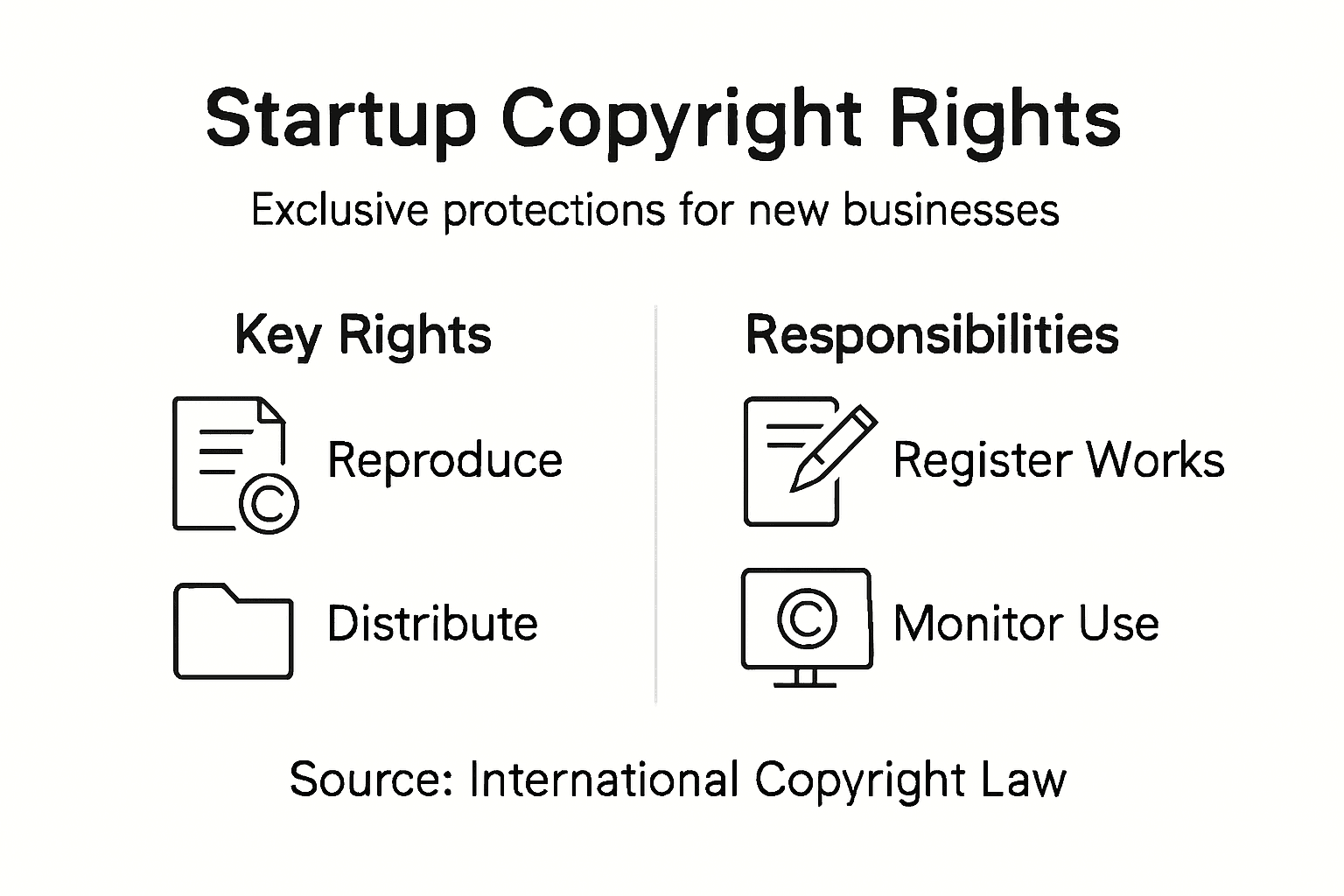
The legal framework provides startup founders with several critical exclusive rights, including the ability to reproduce their work, distribute copies, create derivative works, and perform or display their content publicly. These rights are not unlimited, however. Startups must carefully balance their own copyright protections with respecting the intellectual property rights of other entities. This means conducting thorough due diligence to ensure their innovations do not inadvertently infringe on existing copyrights, and developing robust internal processes for verifying the originality of their creative outputs.
Digital content legal protections are particularly crucial for technology-driven startups operating in online environments. The Digital Millennium Copyright Act (DMCA) provides important safeguards, establishing a notice-and-takedown system that limits liability for online service providers under specific conditions. For startup founders, this means implementing comprehensive content moderation strategies, creating clear terms of service, and establishing mechanisms to quickly address potential copyright infringement claims from content creators or rights holders.
Pro Tip: Develop a comprehensive intellectual property audit process that regularly reviews your startup’s creative assets, ensuring ongoing compliance and proactively identifying potential copyright risks.
Common Copyright Risks and Mistakes to Avoid
Startup founders frequently encounter numerous copyright risks that can potentially derail their business strategies and expose them to significant legal vulnerabilities. Copyright protection challenges include several critical mistakes that entrepreneurs must proactively identify and mitigate to protect their intellectual property and avoid costly legal disputes.
One of the most prevalent risks involves misunderstanding the nuances of fair use and unauthorized content reproduction. Many startups mistakenly believe that simply crediting the original source eliminates copyright infringement concerns, when in reality, this does not provide legal protection. Entrepreneurs must develop a comprehensive understanding of licensing requirements, permissions, and the specific parameters that govern content usage across different creative domains such as software, design, marketing materials, and digital media.
Legal liability for copyright mistakes can be particularly devastating for emerging companies. Common pitfalls include assuming that works without an explicit copyright notice are free to use, reproducing content without proper permissions, and failing to understand the complex legal landscape surrounding intellectual property rights. Startup founders must implement robust internal processes that include thorough content verification, obtaining necessary licenses, and maintaining meticulous documentation of original work and permissions.
Pro Tip: Invest in periodic copyright compliance training for your team and establish a standardized review process that thoroughly vets all content and creative assets before publication or distribution.
Secure Your Startup’s Innovation with Expert Copyright Protection
Navigating the complexities of copyright law is essential for startups seeking to protect their unique creations and avoid costly legal risks. This article highlights key challenges such as distinguishing original work, understanding fair use, and managing international protections. If your startup is ready to safeguard its software, marketing assets, or digital content with a robust legal strategy, expert guidance is critical.
At Studio Legale Coviello, we specialize in intellectual property and international commercial law, offering tailored legal advice that empowers startups to confidently protect their copyrights and business innovations worldwide. Benefit from cutting-edge solutions including AI-enhanced legal services and user-friendly digital tools designed to simplify your rights management.
Take control of your startup’s creative assets today. Visit our site to explore how our specialized legal consultancy services can help you build a strong intellectual property foundation and secure your innovation against infringement risks.
Frequently Asked Questions
What is copyright law and why is it important for startups?
Copyright law protects original creative works, granting exclusive rights to creators. For startups, it is essential to safeguard innovative content from unauthorized use, enabling them to control and monetize their intellectual property effectively.
What types of works can be protected by copyright?
Copyright can protect a variety of creative works including software code, marketing materials, visual designs, technical documentation, and digital content, as long as they are original and fixed in a tangible medium.
How does international copyright law affect startups?
International copyright law provides a framework that ensures creators can protect their works globally through treaties like the Berne Convention and WIPO treaties. Startups can benefit by knowing their intellectual property is safeguarded as they expand into new markets.
What common mistakes do startups make regarding copyright?
Startups often make mistakes such as misunderstanding fair use, assuming unmarked works are free to use, and not obtaining necessary licenses. These can expose them to legal liabilities, so developing strong internal compliance processes is crucial.
Recommended

Comments