


Copyright Protection: Safeguarding Digital Innovation

Bold ideas deserve robust protection, yet many European and American tech entrepreneurs underestimate how quickly copyright myths can compromise digital assets. In a rapidly shifting global market, more than $600 billion in creative works are lost to infringement each year. Understanding the real power and practical limits of copyright laws equips startups with smarter strategies to shield software, multimedia, and design from costly risks and confusion.
Table of Contents
Key Takeaways
Point | Details |
Copyright Protection is Automatic | Copyright is automatically secured upon the creation of an original work, though registration enhances legal advantages. |
Wide Range of Original Works Covered | Copyright law protects various categories including literary, visual, performing, and audiovisual works. |
Important Legal Rights for Creators | Creators have exclusive rights to reproduce, distribute, and create derivative works from their original creations. |
Risks of Infringement | Unauthorized use of copyrighted materials can lead to severe legal consequences, regardless of intent. |
Copyright protection defined and common myths
Copyright is a critical legal mechanism designed to protect original creative works and safeguard digital innovation for entrepreneurs and tech creators. Copyright protection exists as a fundamental intellectual property right that preserves creators’ exclusive rights to their original artistic, literary, musical, and digital works.
At its core, copyright law protects the specific expression of ideas, not the ideas themselves. This means that while a novel concept cannot be copyrighted, the unique written manuscript describing that concept absolutely can. For digital innovators, this translates into critical protection for software code, design interfaces, digital art, multimedia presentations, and other original digital creations that represent substantial creative effort.
Several persistent myths about copyright often mislead creators and entrepreneurs. Contrary to popular belief, copyright protection is automatic upon creating an original work and does not require formal registration. Intellectual property rights are established the moment a work is fixed in a tangible medium - whether published or unpublished. However, registration does provide additional legal advantages, such as the ability to sue for damages and establish a public record of ownership.
Pro tip: Always maintain comprehensive documentation of your creative process and original work, including dated drafts and design iterations, to provide clear evidence of your copyright ownership.
Types of works covered by copyright law
Copyright law provides comprehensive protection for a wide array of creative works across multiple domains. Copyright protection extends to diverse categories including literary works, visual arts, performing arts, and digital content, offering creators robust legal safeguards for their intellectual contributions.
The legal framework specifically covers several distinct categories of original works. These include literary works such as novels, articles, and computer software; visual arts encompassing photographs, sculptures, and graphic designs; performing arts like musical compositions, plays, and choreography; and audiovisual works including films, videos, and digital media presentations. Importantly, copyright law recognizes that many contemporary creative works blend multiple categories, and protection adapts accordingly.
Derivative works and compilations also receive significant legal protection, provided they demonstrate sufficient originality and transformative creative input. This means that while raw facts, ideas, or short phrases cannot be copyrighted, unique arrangements, innovative presentations, and substantial creative interpretations of existing materials can qualify for intellectual property rights. For digital entrepreneurs and creators, this framework ensures that complex, multi-layered creative products receive appropriate legal recognition and protection.
Here’s an overview of original work types and unique copyright considerations:
Category | Examples | Special Considerations |
Literary Works | Novels, articles, software code | Protects detailed expression, not ideas |
Visual Arts | Photographs, graphic designs | Covers arrangement and creative choices |
Performing Arts | Plays, musical scores, choreography | Public performance rights included |
Audiovisual Works | Films, videos, multimedia | Includes both visuals and sound |
Derivative Works | Adaptations, compilations | Must show originality, not just copying |
Pro tip: Before publishing any work, carefully document your creative process and maintain clear records showing the evolution and originality of your intellectual creation.
How copyright law functions globally
International copyright protection is a complex network of agreements designed to safeguard creative works across national boundaries. Global copyright treaties establish critical mechanisms that ensure creators receive consistent legal protections regardless of their geographic location, creating a unified approach to intellectual property rights.
The primary framework for global copyright enforcement involves several key international agreements. The Berne Convention, established in 1886, forms the cornerstone of international copyright law, mandating that member countries recognize and protect copyrights originated in other signatory nations. Subsequent treaties like the World Intellectual Property Organization (WIPO) Copyright Treaty and the Trade-Related Aspects of Intellectual Property Rights (TRIPS) agreement have further refined these protections, addressing emerging challenges in digital and technological domains.
International copyright mechanisms operate through a system of mutual recognition and standardized minimum protections. While specific enforcement varies between countries, the fundamental principle remains consistent: protecting original creative works and preventing unauthorized reproduction or distribution. Digital creators and entrepreneurs benefit from this framework, which provides a predictable legal environment for intellectual property rights across different jurisdictions, enabling global collaboration and innovation.
The following table compares global copyright treaties and their business impact:
Treaty Name | Year Established | Key Focus | Impact for Creators |
Berne Convention | 1886 | Mutual recognition | Automatic protection in member countries |
WIPO Treaty | 1996 | Digital works, updates | Adapts standards for new tech and the web |
TRIPS Agreement | 1995 | Trade/IP harmonization | Aligns IP enforcement with global commerce |
Pro tip: When creating international digital content, always research the specific copyright regulations in your target markets to ensure comprehensive legal protection.
Key rights and obligations for creators
Copyright law grants creators a comprehensive set of exclusive rights that protect their intellectual property and provide mechanisms for controlling the use of their original works. Creators’ fundamental rights include the ability to reproduce, distribute, perform, display, and develop derivative works based on their original creation, ensuring they maintain control over their intellectual assets.

These rights extend beyond simple ownership, encompassing complex legal protections that allow creators to monetize and regulate their works. Creators can license their rights to others, negotiate usage terms, and receive compensation for the exploitation of their intellectual property. The duration of these rights is substantial, typically lasting for the creator’s lifetime plus an additional 70 years, which provides long-term protection and potential generational value for creative and innovative works.
Copyright ownership mechanisms also include nuanced scenarios such as ‘work for hire’ arrangements, where employers may retain rights to works created during employment. This framework ensures that both individual creators and organizational entities have clear pathways for protecting their intellectual contributions, balancing the interests of creators, employers, and the broader creative ecosystem.
Pro tip: Always document the creation process and maintain detailed records of your original work to strengthen your legal position in potential copyright disputes.
Risks, pitfalls, and infringement liabilities
Copyright infringement represents a significant legal and financial risk for creators and organizations engaging with intellectual property. Copyright infringement penalties can be severe, ranging from financial damages to potential criminal charges, with statutory penalties reaching up to $150,000 per willful violation, regardless of the infringer’s intent or awareness.
The legal landscape of copyright infringement is complex and unforgiving. Unauthorized use of copyrighted materials can occur through multiple channels, including reproduction, distribution, public performance, or creation of derivative works without proper permissions. These violations are not dependent on intentional misconduct; even unintentional infringement can result in substantial legal consequences, making it crucial for digital entrepreneurs and content creators to understand and meticulously respect intellectual property boundaries.
Legal liability mechanisms provide several potential defenses for those facing infringement claims, such as demonstrating fair use, proving independent creation, or showing that the material in question is not actually copyrightable. However, these defenses require sophisticated legal understanding and cannot be relied upon as a default protection strategy. Proactive risk management, including obtaining proper licenses, conducting thorough due diligence, and maintaining clear documentation, remains the most effective approach to avoiding copyright disputes.
Pro tip: Develop a comprehensive copyright clearance protocol that includes systematic checks and documentation before using any third-party creative content.
Copyright registration, enforcement, and best practices
Copyright registration provides critical legal protections and strategic advantages for creators seeking to safeguard their intellectual property. Copyright registration procedures offer significant benefits, including establishing a public record of ownership, creating a presumption of validity, and enabling creators to pursue legal action with enhanced remedies such as statutory damages and attorney’s fees.
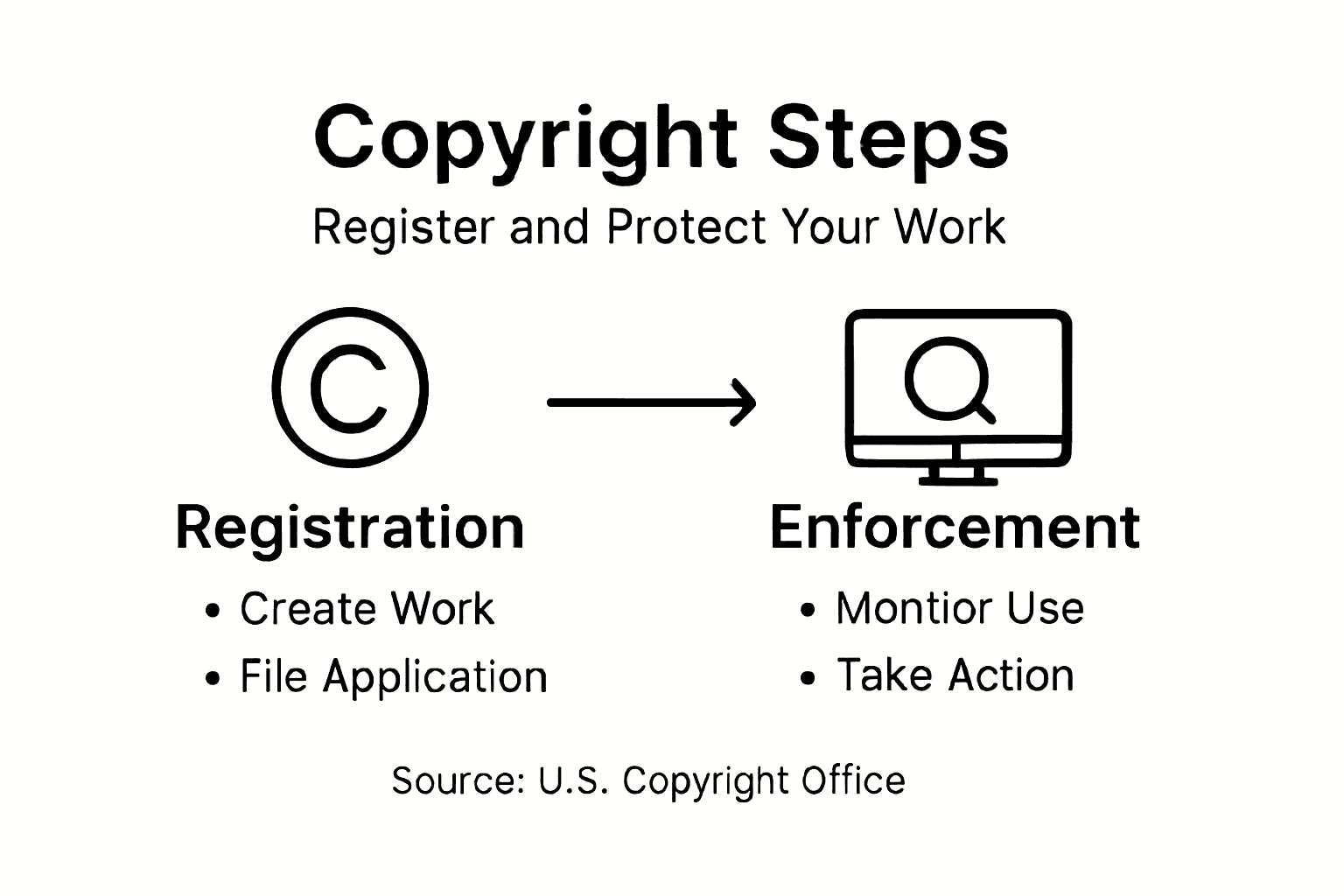
The registration process involves submitting a formal application to the U.S. Copyright Office, which requires specific documentation, application forms, and accompanying fees. Digital creators must understand that while copyright protection exists automatically upon creation, official registration provides substantial legal advantages. Prompt registration after work publication strengthens the creator’s position in potential infringement disputes and serves as a crucial preventative legal strategy.
Copyright enforcement mechanisms encompass more than just legal action. Effective protection involves proactive strategies such as using proper copyright notices, maintaining comprehensive documentation of original work, and developing clear licensing and usage guidelines. These practices not only deter potential infringement but also establish a clear framework for how intellectual property can be used, shared, or licensed by third parties.
Pro tip: Maintain a systematic digital archive of your creative works, including drafts, timestamps, and development notes, to provide robust evidence of original creation and ownership.
Protect Your Digital Creations with Expert Legal Guidance
In a world where digital innovation thrives, safeguarding your original works against infringement is more important than ever. This article highlights common copyright challenges such as understanding exclusive rights, navigating international protections, and managing risks related to unauthorized use. If you are looking to confidently protect your literary, visual, or digital assets, including software code or multimedia content, professional legal advice can make all the difference in securing your intellectual property.

Take control of your creative future today by partnering with Studio Legale Coviello. Our expertise in intellectual property and international commercial law, combined with cutting-edge technology like artificial intelligence and digital tools, provides tailored strategies to defend your copyrights effectively. Do not wait for disputes to arise. Visit us now to learn how our specialized services can help you document, register, and enforce your rights with confidence and precision.
Frequently Asked Questions
What is copyright protection?
Copyright protection is a legal mechanism that safeguards original creative works, allowing creators exclusive rights to their artistic, literary, musical, and digital works as soon as they are fixed in a tangible medium.
Do I need to register my work to receive copyright protection?
No, copyright protection is automatic upon the creation of a work. However, formal registration with the copyright office provides additional legal benefits, such as the ability to sue for damages and establishing a public record of ownership.
What types of works are covered by copyright law?
Copyright law covers a diverse range of original works, including literary works (like novels and articles), visual arts (such as photographs and graphic designs), performing arts (like music and plays), audiovisual works (like films and videos), and derivative works, provided they show originality.
What are the risks of copyright infringement?
Copyright infringement can lead to severe legal and financial penalties, including statutory damages up to $150,000 per willful violation. Unauthorized use of copyrighted material, even inadvertently, can result in substantial legal consequences.
Recommended

Comments